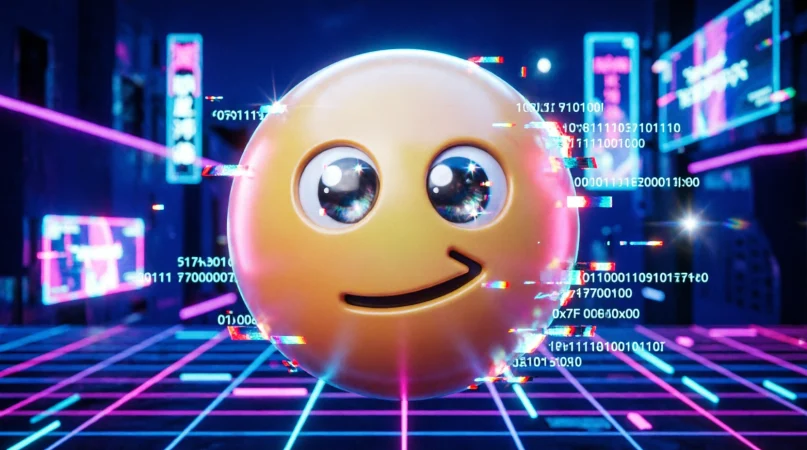
� is not a normal emoji with a fixed emotional meaning. It is the Unicode Replacement Character. When it appears in a message, webpage, file, or social post, it usually indicates that an original character, symbol, or emoji could not be decoded or displayed correctly.
If you searched for the � emoji, you are most likely looking at the Unicode Replacement Character, not a standard emoji. The symbol � has the Unicode code point U+FFFD and is officially called REPLACEMENT CHARACTER. It is used when a system cannot correctly decode, display, or represent another character.
In other words, � usually means that something else was supposed to appear, but the original character could not be interpreted correctly. This can happen with damaged text, incompatible character encoding, unsupported characters, or an emoji that was not transferred correctly. If you expected to see an emoji but instead see �, the symbol itself usually does not tell you which emoji was missing.
What Is the � Symbol?
The symbol � is called the Replacement Character in Unicode.
Unicode defines U+FFFD as a general substitute character. It may be used when an unknown character cannot be mapped correctly or when a conversion process encounters an ill-formed sequence.
That makes it different from ordinary emoji such as:
- 😀 Grinning Face
- ❤️ Red Heart
- 😂 Face with Tears of Joy
- 🎓 Graduation Cap
- 🥰 Smiling Face with Hearts
Those characters have established pictorial identities and are normally displayed as recognizable symbols. The replacement character, by contrast, is a fallback marker for a text or encoding problem.
So if someone asks, “What does the � emoji mean?” the most accurate answer is:
It usually does not represent an intended emoji. It indicates that another character may have been lost, corrupted, or could not be decoded.
Why Does � Appear Instead of an Emoji?
A common reason is a character-encoding problem.
Computers store and exchange text using encoded data. Unicode provides a standard way to represent characters across different systems, but software still has to correctly interpret that data.
When text is converted between encodings, a system can encounter data that it cannot interpret. Unicode specifies U+FFFD as a substitution character for this situation.
For example, imagine that someone sends:
“Congratulations! 🎓”
If the graduation-cap character or the surrounding data is damaged during processing, the receiving system might not be able to reconstruct the original character. Instead of displaying 🎓 correctly, the system may show:
“Congratulations! �”
The � symbol does not mean “graduation.” It means that the original character could not be represented correctly at that point.
The same thing can happen with letters, symbols, punctuation, and other Unicode characters. It is not limited to emoji.
Is � Actually an Emoji?
No. The � character itself is not a standard emoji.
Unicode’s emoji documentation explains that emoji are colorful pictographs that can be used inline with text. The Unicode Standard separately defines U+FFFD as the general replacement character used for unknown or unrepresentable characters.
This distinction matters because a search for “� emoji meaning” can be misleading.
If you see �, there are two different possibilities:
- You are seeing the replacement character itself.
- You expected an emoji, but the intended emoji was replaced by � because of a decoding or display problem.
In the second case, � does not reveal the original emoji with certainty.
What Does � Mean in Text?
When � appears in a text message, webpage, document, or post, its meaning is usually technical rather than emotional.
It can indicate that:
- A character could not be decoded.
- Text was converted incorrectly.
- Data was damaged or malformed.
- A character was not represented correctly during conversion.
- A system substituted a missing or unknown character.
- An emoji or symbol was lost during processing.
For example:
“See you tomorrow �”
The symbol at the end does not necessarily represent an emotion.
The missing character could have been an emoji, punctuation mark, or another symbol. Without access to the original data, you generally cannot determine exactly what was intended.
What Does � Mean on a Phone?
If � appears on your phone, it usually means the phone or an app received text containing a character that could not be decoded or displayed correctly.
The cause may be related to the message itself, the application processing it, or the way the text was converted before reaching your device.
It does not necessarily mean that your phone has a broken emoji keyboard.
For example, if a friend sends you a message containing a newly supported character but your software does not handle it correctly, the displayed result may differ from what the sender intended.
Unicode also notes that emoji presentation can vary across platforms and that support for emoji characters can differ between implementations.
What Does � Mean on a Website?
On a website, � can indicate that the page contains text that was not decoded correctly.
This can happen when:
- The source file uses one character encoding but the software assumes another.
- Text was converted between incompatible encodings.
- Data was corrupted.
- A character was improperly processed.
- An application replaced an unrecognized character with U+FFFD.
Unicode specifically describes encoding conversion errors as one situation in which U+FFFD may be used.
If you see several � symbols scattered throughout an article, that is a strong sign that some characters in the underlying text were not interpreted correctly.
Why Does � Sometimes Look Like a Diamond With a Question Mark?
The character is commonly rendered visually as a diamond containing a question mark:
�
That visual design can make people think it is an emoji or an unusual question-mark emoji.
However, the shape is simply the way a font or system displays the Replacement Character. The character’s purpose is to indicate a substitution or decoding problem.
The appearance can vary somewhat depending on the font and software, but the underlying Unicode character is U+FFFD.
� vs. ❓: Are They the Same?
No.
The ❓ Red Question Mark is an actual symbol commonly used to express a question, uncertainty, confusion, or a request for clarification.
The � Replacement Character is a technical fallback character.
Compare:
“What happened? ❓”
The ❓ contributes meaning to the message.
By contrast:
“What happened? �”
The � may indicate that some other character failed to display. It does not automatically mean confusion or a question.
� vs. �: Why Does the Search Keyword Look Different?
Sometimes the same underlying replacement character appears as different text depending on how it has been encoded or displayed.
The keyword “>��� emoji” is particularly useful to understand because � is a common form of encoding corruption associated with the character �.
In UTF-8, U+FFFD is represented by the byte sequence EF BF BD. If that data is incorrectly interpreted using another encoding, the visible text can become something like:
�
Repeated replacement characters can therefore produce:
���
That is not a special three-part emoji. It is a sign that character data has likely gone through an encoding mismatch or another text-conversion problem.
The sequence � is documented as a mojibake representation of U+FFFD under an incorrect Windows-1252 interpretation.
The leading > in a search phrase such as:
��� emoji
may simply be punctuation, quoting, or formatting carried into the search text. It does not turn the replacement character into a separate emoji.
Common Examples of the Replacement Character
Example 1: A Missing Emoji
Suppose someone intended to send:
“Happy birthday! 🎂🎉”
but the receiving system cannot process part of the message.
You might see:
“Happy birthday! �”
The � does not mean cake or celebration. The original emoji may simply have been lost.
Example 2: Damaged Text
A document might contain:
“Welcome to the caf�”
The intended word could have been “café.”
Here, the replacement character may indicate that the accented character é was not handled correctly.
Example 3: Several Missing Characters
You might encounter:
“I � this � yesterday.”
The missing characters could have been words, symbols, or characters that were damaged during a conversion process.
The replacement character alone cannot tell you what those missing characters were.
Example 4: A Broken Emoji Sequence
Someone might intend to send:
“That is hilarious 😂”
but a processing problem could result in:
“That is hilarious �”
The visible symbol should not be interpreted as “laughing.” The original emoji is no longer identifiable from the replacement character alone.
Emojis and Symbols Related to �
Because � is not an emotional emoji, the most useful comparisons are symbols that people may mistake for it or characters that can appear when text is unclear.
| Emoji | Official Name | Common Meaning | Tone | Where or When It Is Used |
|---|---|---|---|---|
| � | Replacement Character | Missing, unknown, or unrepresentable character | Technical, neutral | Broken text, encoding errors, unsupported or corrupted characters |
| ❓ | Red Question Mark | Question, uncertainty, confusion | Curious, uncertain | Questions, clarification, confused reactions |
| ❗ | Red Exclamation Mark | Emphasis, warning, strong reaction | Urgent, emphatic | Warnings, strong statements, important messages |
| ⁉️ | Exclamation Question Mark | Surprise, disbelief, or a question with emphasis | Dramatic, surprised | Reactions, confusing situations, strong questions |
| ❔ | White Question Mark | Question or uncertainty | Neutral, curious | Questions and requests for clarification |
| ⚠️ | Warning | Caution, danger, or something requiring attention | Serious, cautionary | Warnings, alerts, safety-related messages |
The Most Important Difference
The key distinction is between � and actual expressive symbols.
❓, ❗, ⁉️, ❔, and ⚠️ are intentionally used to communicate ideas or reactions.
The Replacement Character is generally not communicating the sender’s emotion. It is telling the software, in effect, that a character could not be represented correctly.
That is why you should not automatically read � as confusion, anger, surprise, or sarcasm.
Does � Have a Hidden or Secret Meaning?
There is no standard emotional meaning attached to U+FFFD.
If someone deliberately types or posts �, they could give it a personal or humorous meaning. People can repurpose symbols in creative ways, and Unicode itself explains that emoji meanings can vary with context and can change over time.
However, when � appears unexpectedly inside normal text, the safer interpretation is that something went wrong with the text representation.
Do not assume that it secretly means:
- “I am angry”
- “I am confused”
- “I miss you”
- “I love you”
- “I am joking”
- “I am flirting”
Those meanings would have to come from the surrounding message, not from the replacement character itself.
Is � a Flirting Emoji?
No. The Replacement Character is not inherently romantic or flirty.
If someone sends:
“I miss you �”
the symbol at the end does not tell you what the sender intended.
The missing character could have been ❤️, 😊, 😘, or something completely unrelated. You would need the original message or additional context to know.
This is a good example of why a corrupted character should not be interpreted like a normal emoji.
What Does � Mean From Someone?
If someone sends you a message containing �, the most useful first assumption is that the message may not have displayed correctly.
For example:
“Look what I got �”
Instead of guessing what the symbol means, you could ask:
“What was supposed to be there? The character came through as �.”
That is especially useful when the missing character could change the meaning of the message.
If the sender says they intentionally typed � as a joke, then their personal context determines its meaning.
Can � Be Used Sarcastically?
It can be used deliberately in a joke, but sarcasm is not part of its standard meaning.
Someone might intentionally write:
“My computer is working perfectly �”
as a joke about a technical problem.
Here, the humor comes from the situation and wording. The Replacement Character itself still has its technical meaning.
This distinction is useful when reading unusual messages: a character can be intentionally used in a humorous way without having a standard humorous definition.
How to Respond When Someone Sends �
If the surrounding message is understandable, you may not need to respond to the symbol at all.
If the missing character affects the meaning, ask for clarification:
“I think one of your characters didn’t come through. What was that supposed to be?”
For a casual conversation:
“What was the � supposed to be? 😄”
If you suspect an emoji was lost, you can simply ask the sender to resend it.
This is usually better than guessing, especially when the missing symbol could have emotional or relationship-related meaning.
How to Fix the � Symbol
If you frequently see � where normal characters or emojis should appear, the problem may involve text encoding, software compatibility, corrupted data, or an application that does not correctly process the original character.
Some practical steps include:
Ask the sender to resend the message
If only one message is affected, resending it may solve the problem.
Update the relevant app
An outdated application may have incomplete support for newer characters or emoji sequences.
Check the original file or source
If the problem occurs in a document or webpage, the source may have been saved or interpreted using the wrong character encoding.
Preserve the original data
If the issue involves a file or database, replacing � with a guessed character can make the original information harder to recover. The replacement character may indicate that the original data has already been lost during decoding.
Check character encoding
For technical workflows, make sure the source and destination systems agree on the character encoding, commonly UTF-8 for modern text interchange.
Unicode describes U+FFFD as a substitution used when conversion encounters unconvertible data, including ill-formed sequences.
Can You Copy and Paste the Replacement Character?
Yes.
You can copy it here:
�
Its Unicode code point is:
U+FFFD
Its official Unicode name is:
REPLACEMENT CHARACTER
Keep in mind that copying � does not restore the original character that was lost. It simply copies the replacement character itself.
If you are trying to recover a missing emoji, you need the original data or the sender’s message rather than another copy of �.
Official Name and Technical Details
The technical details of the symbol are straightforward:
- Character: �
- Official Unicode name: REPLACEMENT CHARACTER
- Code point: U+FFFD
- Decimal value: 65533
- Unicode block: Specials
- Unicode version: 1.1
- Purpose: General substitute for an unknown or unrepresentable character
Unicode’s current specification describes U+FFFD as the general substitute character and explains that it can be used when an unknown character cannot be mapped correctly or when an ill-formed sequence is encountered during conversion.
The character was added to Unicode in Unicode 1.1, dating to 1993.
Unlike a normal emoji, it does not have an emoji version or an intended pictographic meaning such as happiness, sadness, celebration, or affection.
Frequently Asked Questions
What does the � emoji mean?
� is not a standard emoji. It is the Unicode Replacement Character, U+FFFD. It usually appears when another character cannot be decoded, represented, or displayed correctly.
Why do I see � instead of an emoji?
The original emoji may have been affected by an encoding problem, unsupported character handling, corrupted data, or a conversion error. The replacement character does not reveal which emoji was originally intended.
Is � an emoji?
No. It is a Unicode character used as a general substitute for unknown or unrepresentable characters.
What is the Unicode code for �?
The code point is U+FFFD.
What is the official name of �?
The official Unicode name is REPLACEMENT CHARACTER.
Does � mean something is wrong with my phone?
Not necessarily. The problem could originate in the message, webpage, file, application, encoding process, or another part of the data path.
What does � mean?
� is commonly produced when the UTF-8 bytes representing U+FFFD are interpreted using the wrong character encoding. It is a form of garbled text known as mojibake rather than a separate emoji.
Can � represent a missing heart emoji?
Possibly, but you cannot know from � alone. If a ❤️ was lost during processing, the replacement character could appear in its place, but another missing character could produce the same result.
Does � mean confusion?
Not by itself. A real question or confusion emoji such as ❓ has an expressive meaning. � generally indicates a character-representation problem.
Final Takeaway
The symbol � is best understood as a technical replacement character, not as an emoji with a secret emotional meaning. It is officially called REPLACEMENT CHARACTER and has the Unicode code point U+FFFD.
When it appears where an emoji, letter, or symbol should be, the original character may have been lost or could not be decoded correctly. The sequence � is another common sign of this kind of encoding problem.
If you receive � in a personal message, avoid guessing what the sender meant. Ask them to resend the missing character when the context matters.

Michael Anderson is a content writer at EmojissLife.com, where he creates fun, relatable, and easy-to-read emoji guides, meanings and creative ideas. He enjoys turning everyday conversations into expressive content that helps readers find the perfect emojis for every mood and moment.
2 thoughts on “�Emoji Meaning: What Does the Replacement Character Mean For 2026”