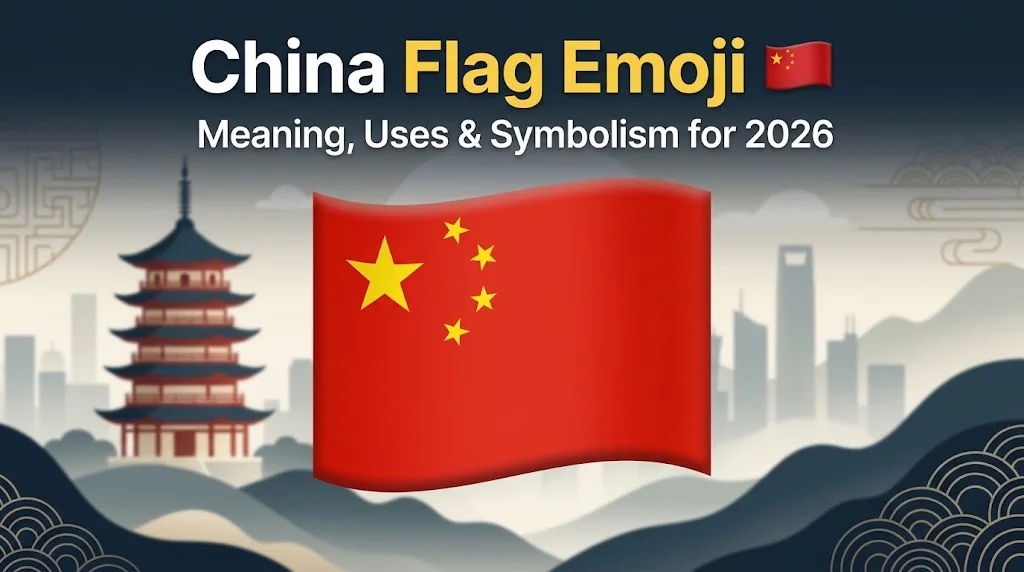
The 🇨🇳 China flag emoji means China or something associated with China. It is the national flag emoji for China and is generally neutral and informational. Depending on the message, it can refer to Chinese culture, travel, language, food, sports, national identity, or China-related news and discussions.
The 🇨🇳 China flag emoji represents China and is officially named Flag: China in Unicode. It is commonly used when talking about China, Chinese culture, travel, food, language, sports, geography, people, businesses, or events connected with the country. It can also express national identity or support for a Chinese team or representative.
Unlike face emojis, 🇨🇳 does not have a fixed emotional meaning. Its tone depends on the conversation. In a travel message, it may simply identify a destination. In a sports discussion, it can represent a Chinese team. In a political conversation, it may refer to China as a country or to a China-related issue. Context is essential.
What Does the 🇨🇳 China Flag Emoji Mean?
The most direct meaning of 🇨🇳 is China.
Someone might use it to identify:
- China as a country
- A trip to China
- Chinese language or culture
- Chinese food
- A Chinese city or destination
- A Chinese athlete or sports team
- A China-related business or event
- National identity
- A topic involving China
For example:
“I’m traveling to Shanghai next month 🇨🇳”
Here, the flag reinforces the destination.
Another example:
“Chinese food tonight 🇨🇳🥟”
The flag helps establish the cultural or national connection.
The same emoji can also appear in a simple location list:
“China 🇨🇳
Japan 🇯🇵
South Korea 🇰🇷”
In that case, it is mainly a country identifier.
What Does 🇨🇳 Mean in Texting?
In texting, 🇨🇳 usually works as a visual shorthand for China.
Its meaning may depend on what the sender is discussing.
Travel
“Beijing is on my list 🇨🇳✈️”
The flag indicates China as the travel destination.
Language
“I’m starting to learn Mandarin 🇨🇳”
Here, the emoji connects the message with China or Chinese language and culture.
Food
“Let’s get dumplings tonight 🇨🇳🥟”
The flag adds a Chinese cultural association to the message.
Sports
“China made it to the final 🇨🇳🏆”
The flag can identify a Chinese national team or representative.
Geography
“Shanghai 🇨🇳”
The emoji simply identifies the country associated with the city.
In these examples, the flag does not necessarily add an emotional reaction. It often provides context.
What Is the Tone of the China Flag Emoji?
🇨🇳 is generally neutral and informational, but it can take on a stronger tone depending on the surrounding message.
A travel post may make it feel enthusiastic:
“Finally visiting Beijing! 🇨🇳❤️”
A sports message may make it feel celebratory:
“What a match! 🇨🇳🏆”
A personal statement may make it express identity or pride:
“Proud of where my family comes from 🇨🇳”
A political discussion may give it a serious or contentious context:
“The discussion focuses on China’s foreign policy 🇨🇳”
The emoji itself does not tell you whether the sender agrees or disagrees with the subject. The words around it matter more.
Does 🇨🇳 Mean Chinese Culture?
It can be used to refer broadly to Chinese culture, but the flag itself specifically represents China.
For example:
“Chinese New Year decorations 🇨🇳🧧”
The flag may help signal the cultural context.
However, not every Chinese cultural reference should automatically be treated as a statement about nationality. A person might use other emojis, words, or symbols to describe a particular tradition, food, language, or cultural practice.
The best interpretation comes from the complete message.
Does 🇨🇳 Mean “Made in China”?
Not necessarily.
Someone might use the flag while discussing products manufactured in China:
“This phone was manufactured in China 🇨🇳”
In this context, the connection is clear.
But 🇨🇳 by itself does not literally mean “made in China.” It represents China. The manufacturing meaning comes from the accompanying words.
This distinction is useful when interpreting product descriptions, shopping posts, or business conversations.
What Does 🇨🇳 Mean From Someone?
If someone sends you 🇨🇳 by itself, the most reliable interpretation is simply China.
For example, if you ask:
“Where are you traveling?”
and they reply:
“🇨🇳”
they may be saying they are going to China or are currently there.
If someone sends:
“I finally got tickets! 🇨🇳✈️”
the flag is clearly connected to travel.
If the conversation is about food:
“Hot pot tonight 🇨🇳🍲”
the emoji likely provides a Chinese cultural reference.
A single flag emoji usually does not reveal a hidden emotional message. Avoid assuming that it proves pride, political support, disagreement, or any other personal position without additional context.
Is 🇨🇳 a Political Emoji?
The 🇨🇳 emoji represents China, so it can naturally appear in political conversations involving the country.
That does not mean the emoji itself expresses a political position.
For example:
“The leaders are meeting in Beijing 🇨🇳”
is a factual or contextual use.
By contrast:
“I strongly support this policy 🇨🇳”
contains a political opinion expressed by the words, not by the flag alone.
Similarly, someone can use 🇨🇳 while criticizing or discussing a China-related issue. The symbol identifies the subject; the surrounding text establishes the viewpoint.
Is 🇨🇳 a Patriotic Emoji?
It can be used in a patriotic context, especially when someone is expressing personal connection, pride, or support involving China.
For example:
“Cheering for our team tonight! 🇨🇳🏅”
The combination may communicate national support in a sporting context.
However, 🇨🇳 does not automatically mean patriotism. A tourist, researcher, student, journalist, businessperson, or anyone discussing China can use it without making a patriotic statement.
Is 🇨🇳 a Flirting Emoji?
No, 🇨🇳 is not inherently a flirting emoji.
Someone could use it during a romantic conversation if China is relevant to the discussion, but the flag itself does not signal attraction.
For example:
“Our honeymoon destination? 🇨🇳❤️”
The heart creates the romantic element, while the flag identifies the destination.
Without the surrounding context, 🇨🇳 should simply be read as a reference to China.
Can 🇨🇳 Be Used Sarcastically?
Yes, but the sarcasm comes from the context, not from an official meaning of the flag.
For example:
“Another argument about China again 🇨🇳🙃”
The surrounding words and 🙃 may create a sarcastic or frustrated tone.
The flag simply identifies the topic.
It would be misleading to say that 🇨🇳 itself means sarcasm.
China Flag Emoji vs. Similar Flag Emojis
Several nearby flag emojis can be confused with 🇨🇳 because they are associated with China, East Asia, or neighboring countries and regions.
| Emoji | Official Name | Common Meaning | Tone | Where or When It Is Used |
|---|---|---|---|---|
| 🇨🇳 | Flag: China | China, Chinese identity, or China-related topics | Neutral, proud, informative | Travel, culture, sports, geography, national references |
| 🇭🇰 | Flag: Hong Kong SAR China | Hong Kong or topics specifically connected with Hong Kong | Neutral, regional | Travel, location, culture, business, local references |
| 🇲🇴 | Flag: Macao SAR China | Macao or topics specifically connected with Macao | Neutral, regional | Travel, tourism, geography, local references |
| 🇹🇼 | Flag: Taiwan | Taiwan or Taiwan-related topics | Context-dependent | Travel, geography, culture, sports, political discussions |
| 🇯🇵 | Flag: Japan | Japan or Japanese-related topics | Neutral, cultural | Travel, food, language, culture, sports |
| 🇰🇷 | Flag: South Korea | South Korea or Korean-related topics | Neutral, cultural | Travel, culture, language, entertainment, sports |
| 🇲🇳 | Flag: Mongolia | Mongolia or Mongolian-related topics | Neutral, geographic | Travel, geography, culture, national references |
| 🇸🇬 | Flag: Singapore | Singapore or Singapore-related topics | Neutral, informational | Travel, business, geography, culture |
The most important distinction is what location or country the flag identifies. 🇭🇰 and 🇲🇴 are separate flag emoji sequences associated with Hong Kong and Macao, while 🇨🇳 identifies China. Unicode uses regional indicator sequences to represent regions, and supported systems generally display valid pairs as flag emoji.
The nearby flags 🇯🇵 and 🇰🇷 can also appear in conversations about East Asia, but they identify Japan and South Korea rather than China.
🇨🇳 vs. 🇭🇰
These two are especially important to distinguish.
🇨🇳 is Flag: China.
🇭🇰 is Flag: Hong Kong SAR China.
If someone is specifically talking about Hong Kong, using 🇭🇰 provides more precise location information than simply using 🇨🇳.
For example:
“Visiting Hong Kong next week 🇭🇰”
is more specific than:
“Visiting China next week 🇨🇳”
The appropriate symbol depends on what the sender is actually referring to.
🇨🇳 vs. 🇲🇴
Likewise, 🇲🇴 identifies Macao, while 🇨🇳 identifies China.
A message about:
“Macao casinos and tourism 🇲🇴”
uses the regional flag specifically associated with Macao.
A broader statement about China might use:
“Traveling around China 🇨🇳”
The difference is mainly one of geographic specificity.
🇨🇳 vs. 🇹🇼
These flags should not be treated as interchangeable.
🇨🇳 is the flag emoji identified by Unicode as Flag: China, while 🇹🇼 is identified as Flag: Taiwan.
The two can appear in discussions involving geography, travel, culture, sports, or politics. Because such conversations can involve different views and terminology, it is better to read the sender’s exact wording rather than infer a political position from the flag alone.
What Does 🇨🇳 Mean on Social Media?
On social media, 🇨🇳 can be used as a compact visual reference to China.
Common contextual uses include:
“Shanghai food tour 🇨🇳🥢”
“Chinese language practice 🇨🇳📚”
“Heading to Beijing 🇨🇳✈️”
“China at the international tournament 🇨🇳🏆”
It can also appear in captions, comments, profiles, travel posts, sports discussions, and location-related content.
There is no single social-media-specific meaning that replaces its basic association with China.
Why Does the China Flag Emoji Look Different on Some Devices?
Emoji artwork can vary between platforms and software versions. The underlying Unicode sequence remains the same, but the visual design can differ in details such as proportions, shading, colors, and rendering.
Unicode also explains that flag emoji are based on regional indicator sequences and that the actual displayed flag artwork is handled by the software or platform. The Unicode Consortium does not control the design used by individual vendors.
As a result, 🇨🇳 may look slightly different on an iPhone, Android device, website, or other system while still representing the same flag.
Some environments may also display country-code letters instead of a flag image. This is particularly relevant when a system does not provide full national flag emoji support.
How Is 🇨🇳 Created Technically?
The China flag emoji is not stored as one ordinary Unicode character.
It is a flag sequence made from two regional indicator symbols:
- 🇨 — Regional Indicator Symbol Letter C
- 🇳 — Regional Indicator Symbol Letter N
Together, 🇨 + 🇳 form the China flag emoji on supported systems.
The Unicode code points are:
- 🇨 — U+1F1E8
- 🇳 — U+1F1F3
Unicode’s flag system uses pairs of regional indicator symbols to represent regions. The pair CN corresponds to China.
This technical detail explains why copying the emoji as text still works as a Unicode sequence even though you see one flag on a compatible device.
When Should You Use 🇨🇳?
Use 🇨🇳 when the connection with China is clear and useful.
It works naturally in:
- travel posts
- country lists
- geography discussions
- Chinese language topics
- Chinese food references
- cultural discussions
- sports content
- international events
- China-related business topics
- personal statements about connection with China
You do not need to add it every time the word “China” appears. If the country is already obvious, the emoji may simply be decorative.
When Could 🇨🇳 Be Misunderstood?
The flag can become ambiguous when the message is very short.
For example:
“🇨🇳”
could mean:
- “China”
- “I am in China”
- “I am traveling to China”
- “This is Chinese”
- “I support the Chinese team”
- “This topic concerns China”
Without additional words, you cannot know which interpretation the sender intended.
A longer message removes much of that uncertainty:
“I’m studying Chinese history 🇨🇳📚”
is much easier to understand.
How Should You Respond to 🇨🇳?
If the meaning is clear, respond to the actual topic.
For a travel message:
“Have a great trip!”
For a food conversation:
“That sounds delicious!”
For a sports discussion:
“That was a great match.”
If someone sends only 🇨🇳 and you do not know what they mean, a simple clarification works:
“Are you talking about China?”
That is usually better than assigning a hidden meaning to the flag.
Copy and Paste the China Flag Emoji
Copy the emoji here:
🇨🇳
You can also copy it directly from this line:
🇨🇳
Its Unicode sequence is:
U+1F1E8 U+1F1F3
The sequence represents the regional indicators C + N, which correspond to China.
Official Name and Technical Details
| Detail | 🇨🇳 |
|---|---|
| Official Unicode name | Flag: China |
| Emoji sequence | 🇨 + 🇳 |
| Code points | U+1F1E8 U+1F1F3 |
| Regional code | CN |
| Type | Flag sequence |
| Represents | China |
| Emoji 1.0 | Added in 2015 |
| Unicode flag system | Regional indicator sequence |
Unicode lists 🇨🇳 as flag: China. Emojipedia describes it as a flag sequence combining the regional indicator symbols for C and N and records its addition to Emoji 1.0 in 2015.
Frequently Asked Questions
What does the 🇨🇳 emoji mean?
🇨🇳 is the Flag: China emoji. It represents China and can be used for Chinese culture, travel, language, sports, geography, national identity, and other China-related subjects.
What does the China flag emoji mean in texting?
In texting, 🇨🇳 usually acts as a shorthand for China or something connected with China. Its exact purpose depends on the surrounding message.
Is 🇨🇳 a patriotic emoji?
It can be used to express national pride or support, but it does not automatically mean patriotism. Context determines whether the sender is simply identifying China or expressing a stronger personal feeling.
Is 🇨🇳 a political symbol?
It can appear in political discussions because China is often the subject of those discussions. However, the emoji itself identifies China and does not establish the sender’s political position.
Does 🇨🇳 mean Chinese?
It can be used informally to signal something Chinese, such as food, language, culture, or a person or team associated with China. The flag itself officially identifies China rather than serving as a general dictionary definition of the adjective “Chinese.”
Is 🇨🇳 a flirting emoji?
No. 🇨🇳 has no inherent romantic or flirting meaning. If it appears in a romantic message, the surrounding words and other emojis provide the romantic context.
What is the difference between 🇨🇳 and 🇭🇰?
🇨🇳 is Flag: China, while 🇭🇰 is Flag: Hong Kong SAR China. They identify different regional flag sequences and should not automatically be substituted for one another.
What is the difference between 🇨🇳 and 🇲🇴?
🇨🇳 identifies China, while 🇲🇴 identifies Macao. Use the more specific flag when the conversation is specifically about Macao.
What is the difference between 🇨🇳 and 🇹🇼?
Unicode identifies 🇨🇳 as Flag: China and 🇹🇼 as Flag: Taiwan. They are separate flag emoji and can carry different geographic or political context, so the sender’s wording should be considered carefully.
Why does 🇨🇳 sometimes appear as CN?
Some systems do not render national flag emoji as flag artwork. In those cases, the regional indicator sequence may appear as the letters CN or in another fallback form.
Can I copy and paste 🇨🇳?
Yes. You can copy 🇨🇳 directly and paste it into any compatible app or website.
Final Takeaway
The 🇨🇳 China flag emoji officially represents China. Most of the time, it is a straightforward country or cultural reference rather than an emotional emoji.
Its meaning can become more specific when combined with words or other emojis. 🇨🇳✈️ can point to travel, 🇨🇳🥟 can suggest Chinese food, and 🇨🇳🏆 can identify a Chinese team or sporting context. In political or sensitive conversations, the flag identifies the subject but does not, by itself, reveal the sender’s position.

Michael Anderson is a content writer at EmojissLife.com, where he creates fun, relatable, and easy-to-read emoji guides, meanings and creative ideas. He enjoys turning everyday conversations into expressive content that helps readers find the perfect emojis for every mood and moment.