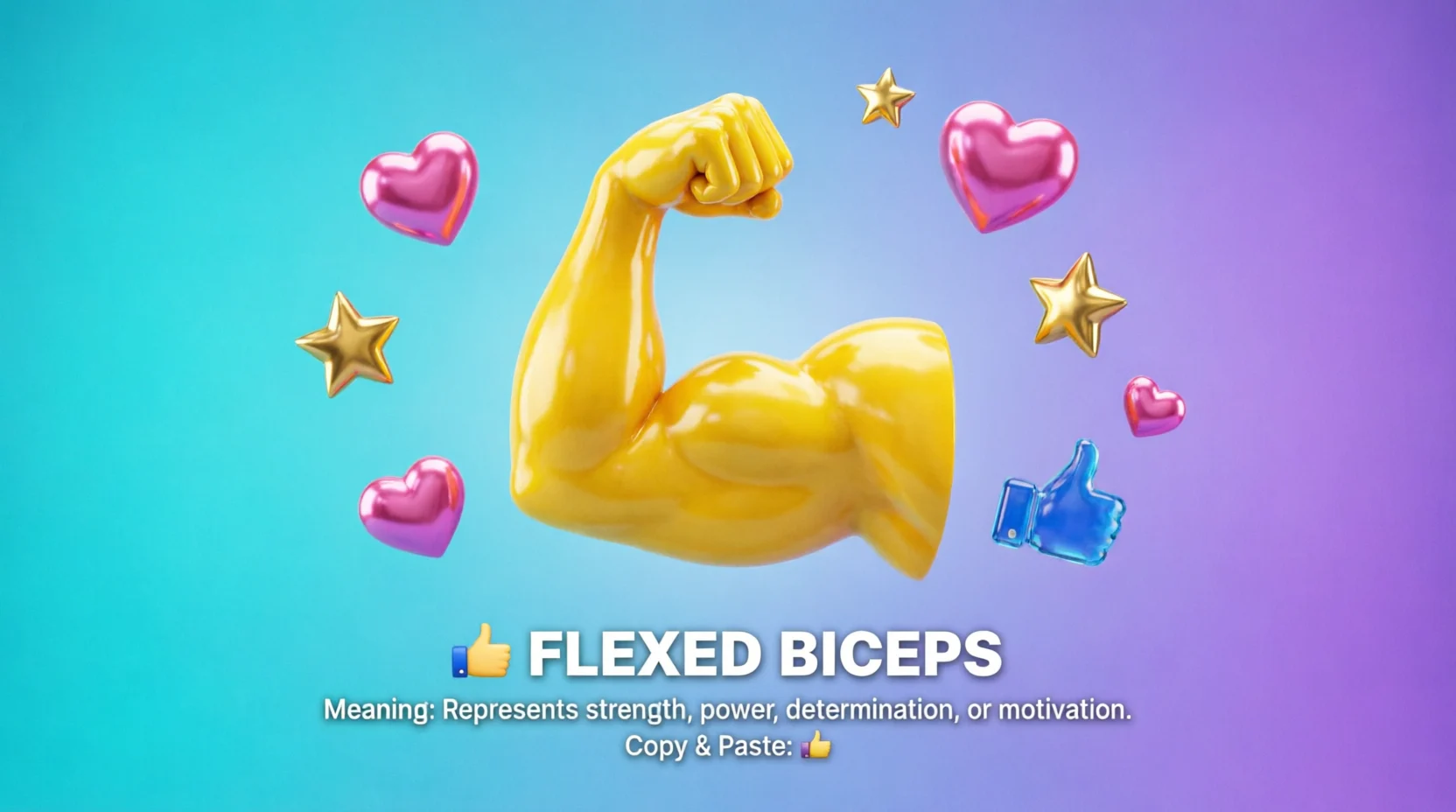
Quick Answer: The arm emoji 💪 is officially called Flexed Biceps. It usually represents strength, power, effort, confidence, or working out. People also use it to show encouragement, determination, support, or pride after accomplishing something. In a playful conversation, 💪 can simply mean “you’ve got this” or “strong!”
The exact meaning depends on the message around it. A friend sending “You can do it 💪” is probably offering encouragement, while “Gym time 💪” points to exercise. It can also be used symbolically for mental strength, hard work, or getting through a difficult situation. Unicode identifies 💪 as “flexed biceps,” with keywords including arm, biceps, flex, strong, gym, and weightlifting.
What Does 💪 Mean?
💪 usually means strength, power, determination, or support. It can refer to physical strength, exercise, confidence, or the idea of staying strong.
Common interpretations include:
- Strength: “I’m strong enough to handle this 💪”
- Motivation: “Keep going 💪”
- Support: “I’m with you 💪”
- Fitness: “Back at the gym 💪”
- Achievement: “Finally finished the project 💪”
- Confidence: “We’ve got this 💪”
It is generally positive, although the tone can become playful, boastful, or sarcastic depending on the conversation.
What Does the Arm Emoji 💪 Usually Mean?
The 💪 emoji shows a bent arm with the biceps flexed. Its official Unicode name is Flexed Biceps, and its primary visual idea is strength. Emojipedia describes it as representing strength and working out, while also noting that it can celebrate physical, mental, or symbolic “feats of strength.”
That gives the emoji a wider meaning than simply “muscles.”
Someone might use 💪 when they:
- Finish something difficult
- Start or talk about exercise
- Encourage another person
- Feel proud of an achievement
- Want to express determination
- Show confidence
- Celebrate progress
- Remind someone to stay strong
For example:
“I finally finished my exam 💪”
Here, the emoji is not necessarily about physical strength. It can emphasize effort and accomplishment.
Strength and Power
The most direct meaning is physical strength.
A message such as:
“Time to hit the gym 💪”
uses the emoji literally to connect the message with exercise, muscles, or fitness.
But strength does not have to be physical. Someone might write:
“This week was hard, but I made it through 💪”
In this context, 💪 suggests emotional or mental strength.
Motivation and Determination
💪 is often used as a small motivational boost.
For example:
“Keep studying. You’re almost there 💪”
The emoji adds a feeling of determination and encouragement without making the message overly serious.
It can work especially well after phrases such as:
- “Keep going 💪”
- “You can do this 💪”
- “Don’t give up 💪”
- “We’ve got this 💪”
Support and Encouragement
Sometimes the arm emoji is less about the sender and more about supporting someone else.
If a friend says:
“I have a big presentation tomorrow.”
A response such as:
“You’ll do great 💪”
can communicate confidence in that person.
In this use, 💪 is similar to saying “Stay strong,” “I believe in you,” or “You’ve got this.”
What Does 💪 Mean in Texting?
In texting, 💪 commonly adds confidence, strength, encouragement, or determination to the words around it.
Its meaning can change depending on the sentence.
| Message | Likely meaning |
|---|---|
| “Workout done 💪” | Exercise or physical strength |
| “You can handle it 💪” | Encouragement |
| “We finished it 💪” | Achievement and pride |
| “Stay strong 💪” | Emotional support |
| “Let’s do this 💪” | Motivation and determination |
| “I’m getting stronger 💪” | Progress or fitness |
The emoji itself does not establish a single emotional message. The surrounding words provide much of the context.
Is 💪 a Friendly or Flirty Emoji?
💪 is usually friendly, motivational, or supportive rather than automatically flirty.
Someone might use it in a romantic conversation, but that does not make the emoji itself a sign of romantic interest.
For example:
“Good luck at your competition 💪❤️”
The ❤️ changes the overall tone and can make the message feel more affectionate.
Compare that with:
“Good luck at your competition 💪”
This is more naturally read as encouragement.
If you are trying to understand whether someone is flirting, look at the whole conversation, not just 💪. Their words, relationship with you, and usual communication style matter more than one emoji.
Can 💪 Be Used Sarcastically?
Yes. Like many emojis, 💪 can be used playfully or sarcastically.
For example:
“I carried all three grocery bags myself 💪”
This could be a genuine statement of strength or a humorous exaggeration about an ordinary task.
Another example:
“I survived Monday 💪”
Here, the emoji adds a dramatic, playful feeling. The person probably is not literally talking about physical strength.
The key is that the surrounding wording determines whether 💪 sounds serious, humorous, or exaggerated.
What Does 💪 Mean From Someone?
When someone sends you 💪 by itself, the most likely interpretation depends on what happened immediately before it.
If you said:
“I’m nervous about tomorrow.”
and they reply:
“💪”
they may be encouraging you to stay confident.
If you said:
“I just finished my workout.”
and they reply:
“💪”
they are probably acknowledging the fitness-related context.
If you said:
“We finally completed the project!”
and they reply:
“💪🔥”
the emojis can reinforce the idea of achievement, energy, or excitement.
There is no universal hidden message behind 💪. Avoid treating a single emoji as proof of a particular feeling or intention.
💪 in Different Emotional Contexts
When It Means Confidence
“I know I can do this 💪”
Here, 💪 strengthens the confident tone.
When It Means Support
“You’re going through a lot, but you’ll get through it 💪”
The emoji acts as encouragement.
When It Means Fitness
“Leg day 💪”
This is directly connected to exercise and physical training.
When It Means Achievement
“Project submitted! 💪”
The emoji celebrates completing something difficult.
When It Means Playful Exaggeration
“Opened the jar on the first try 💪”
The person is humorously presenting a small accomplishment as a major feat.
Related Emojis and Their Meanings
Several emojis can appear alongside 💪 because they express strength, effort, celebration, confidence, or physical activity. They are not interchangeable, though.
| Emoji | Official Name | Common Meaning | Tone | Where or When It Is Used |
|---|---|---|---|---|
| 💪 | Flexed Biceps | Strength, effort, determination | Motivational, confident | Fitness, encouragement, achievements |
| 🦾 | Mechanical Arm | Mechanical or prosthetic arm; strength | Futuristic, strong | Technology, accessibility, symbolic strength |
| ✊ | Raised Fist | Solidarity, determination, resistance | Strong, supportive | Support, unity, standing firm |
| 👊 | Oncoming Fist | Fist bump, greeting, agreement | Friendly, energetic | Greetings, encouragement, shared wins |
| 🙌 | Raising Hands | Celebration, excitement, praise | Joyful | Good news, achievements, celebrations |
| 👏 | Clapping Hands | Applause or approval | Positive, celebratory | Praise, congratulations, reactions |
| 🤝 | Handshake | Agreement, cooperation, partnership | Professional, friendly | Deals, teamwork, mutual support |
| 🫶 | Heart Hands | Love, care, appreciation | Warm, affectionate | Support, gratitude, affection |
| 🏋️ | Person Lifting Weights | Weightlifting or exercise | Active, energetic | Gym and workout conversations |
The closest visual match is 🦾 Mechanical Arm, but its meaning is different: 🦾 represents a mechanical or prosthetic arm rather than simply flexing a muscle. Unicode lists both 💪 and 🦾 as separate body-related emoji, with 💪 officially named “flexed biceps” and 🦾 “mechanical arm.”
✊ Raised Fist can also express strength, but it carries a stronger idea of solidarity or determination. 👊 Oncoming Fist is more commonly connected with a fist bump, greeting, or friendly agreement.
Meanwhile, 🙌 Raising Hands and 👏 Clapping Hands focus more on celebration and approval than physical strength.
💪 vs. 🦾: What’s the Difference?
These two are easy to confuse because both can look like bent arms.
💪 Flexed Biceps shows a human arm flexing its muscle. It is commonly used for strength, fitness, effort, motivation, and encouragement.
🦾 Mechanical Arm represents a mechanical or prosthetic arm. It may also be used symbolically for technology, robotics, or strength. Emojipedia notes that it was approved in Unicode 12.0 in 2019.
So, if you mean “Be strong!”, 💪 is generally the clearer choice. If you are talking about a robotic or prosthetic arm, 🦾 is more specific.
💪 vs. ✊: Strength or Solidarity?
💪 and ✊ can both communicate determination, but their emphasis is different.
💪 usually focuses on strength, effort, motivation, or physical power.
✊ can communicate determination and solidarity, especially when the message is about standing together or supporting a cause.
For a simple “You can do it,” 💪 is usually more straightforward.
💪 vs. 👊: Flexing or Fist Bump?
The difference is mainly visual and conversational.
💪 shows a flexed biceps and is closely associated with strength, exercise, and determination.
👊 shows an oncoming fist and can represent a fist bump, greeting, agreement, or friendly energy.
For example:
“You got this 💪”
feels motivational.
“Nice job 👊”
can feel more like a celebratory fist bump.
How to Use the Arm Emoji Naturally
💪 works best when it reinforces an idea of effort, strength, confidence, or encouragement.
For Motivation
“Keep pushing—you’re almost there 💪”
For Support
“I’m rooting for you 💪”
For Fitness
“Back at the gym 💪”
For Achievement
“Finished the whole assignment 💪”
For Teamwork
“We handled it together 💪”
For Playful Confidence
“I opened that stubborn jar 💪😂”
Adding another emoji can change the tone. For example, 😂 makes the message more humorous, while ❤️ can make a supportive message warmer.
How to Respond to 💪
Your response can depend on why the person sent it.
If they are encouraging you:
“Thank you! I’m going to give it my best 💪”
If they are celebrating an achievement:
“Nice work! 💪👏”
If they mention a workout:
“Nice! Keep it going 💪”
If you are unsure what they mean:
“Haha, what’s with the muscle? 😂”
A simple response is usually enough. There is no need to assign a deeper meaning to the emoji without context.
Can 💪 Represent Mental Strength?
Yes. Although the image shows a physical muscle, people can use it symbolically.
For example:
“It’s been a difficult week, but I’m staying strong 💪”
Here, the emoji represents resilience and determination, not exercise.
This is one reason the emoji can appear in conversations about school, work, personal goals, challenges, or other situations that require effort.
Does the Arm Emoji Have Different Skin Tones?
Yes. 💪 can be combined with Unicode skin-tone modifiers, allowing several skin-tone versions of the Flexed Biceps emoji. Unicode maintains these as modifier sequences, and Emojipedia lists versions such as 💪🏻, 💪🏼, 💪🏽, 💪🏾, and 💪🏿.
The skin-tone variation changes the emoji’s appearance, not its basic meaning.
Does 💪 Look the Same on Every Device?
Not exactly. Apple, Google, Samsung, and other vendors can create their own emoji artwork while following the same Unicode character definition. As a result, the arm, muscle shape, skin tone, and other visual details can vary slightly between devices.
The underlying character remains U+1F4AA, Flexed Biceps.
Official Name and Unicode Details
Here are the basic identification details for 💪:
- Emoji: 💪
- Official Unicode/CLDR name: Flexed Biceps
- Code point: U+1F4AA
- Unicode approval: Unicode 6.0, 2010
- Emoji addition: Emoji 1.0, 2015
- Common keywords: arm, biceps, flex, muscle, strong, gym, weightlifting
Unicode’s current emoji charts identify U+1F4AA as flexed biceps and include keywords such as arm, biceps, bodybuilder, flex, gains, gym, strong, and weightlift.
Common Misunderstandings About 💪
One of the easiest mistakes is assuming that 💪 always means working out. Fitness is one common use, but the emoji can also represent mental strength, support, confidence, effort, or achievement.
Another mistake is assuming that 💪 automatically has a romantic meaning. It can appear in romantic conversations, but the emoji itself does not establish attraction or flirting.
It can also be misleading to read too much into a standalone 💪. A person’s previous message, usual tone, and the subject of the conversation provide much more useful context.
Frequently Asked Questions
What is the official name of the arm emoji?
The official Unicode name for 💪 is Flexed Biceps. It represents a flexed arm showing the biceps.
What does 💪 mean from a friend?
From a friend, 💪 often communicates encouragement, support, confidence, or congratulations. The exact meaning depends on the conversation.
Does 💪 mean strong?
Yes. Strength is one of its main meanings. It can refer to physical strength or symbolic strength such as determination and resilience.
Is 💪 a workout emoji?
It can be. People commonly use it with gym, exercise, weightlifting, and fitness messages. It can also be used outside fitness to express motivation or support.
Is 💪 a flirty emoji?
Not by itself. 💪 is more commonly associated with strength, fitness, encouragement, and confidence. Whether a message is flirty depends on the wider conversation.
What is the difference between 💪 and 🦾?
💪 is the Flexed Biceps emoji and usually represents human strength, exercise, or determination. 🦾 is the Mechanical Arm emoji and represents a mechanical or prosthetic arm.
Can 💪 mean “you can do it”?
Yes. In a motivational message, 💪 can reinforce the idea of “you can do it,” “stay strong,” or “keep going.”
Can I copy and paste the arm emoji?
Yes. Here it is:
💪
You can also choose a skin-tone variation if you want the emoji to match your intended appearance.
Final Takeaway
The arm emoji 💪 officially represents a flexed biceps, but its everyday meaning goes beyond muscles and exercise. It can express strength, determination, encouragement, confidence, effort, support, and achievement.
The best way to understand 💪 is to read it with the surrounding words. In a gym message, it may mean physical strength; in a difficult conversation, it may mean emotional support; and in a joke, it can simply add playful confidence.

Olivia Brown is a content writer at EmojissLife.com, where she creates fun, engaging, and easy-to-read emoji guides, meanings and collections. She enjoys turning everyday expressions into creative content that helps readers find the perfect emoji for every moment.