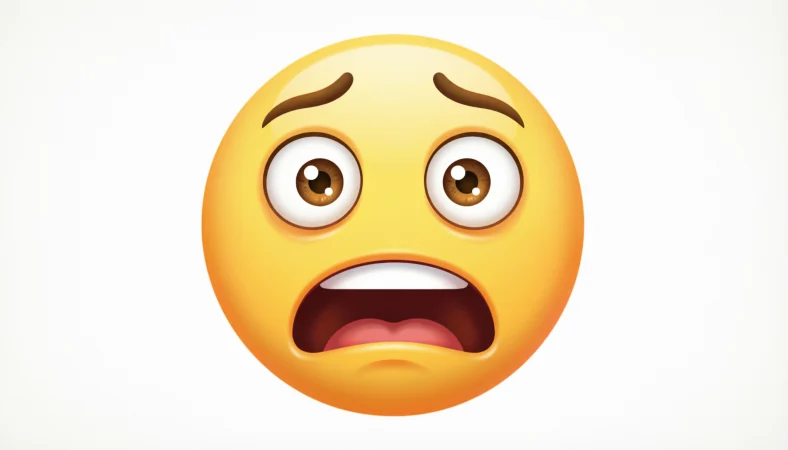
Scared face emoji😨 usually means “I’m scared,” “I’m worried,” or “That makes me nervous.” It has a fearful or uneasy tone, but context matters. For example, “I have to give a speech tomorrow 😨” suggests nervousness, while “I just saw a huge spider 😨” is a more literal reaction to fear.
The scared face emoji 😨, officially called Fearful Face, usually expresses fear, worry, anxiety, or nervousness. It can show that someone feels frightened by a situation or is worried about what might happen next. Depending on the message around it, 😨 can also express shock, distress, surprise, or being overwhelmed. Unicode identifies 😨 as Fearful Face, with the code point U+1F628.
The emoji is not always meant literally. In casual texting, someone might use 😨 to exaggerate a reaction, joke about something scary, or show nervous anticipation.
😨 What the Scared Face Emoji Usually Means
The expression features small open eyes, raised eyebrows, an open frown, and a blue-toned forehead on many designs. The visual is intended to communicate fear or apprehension. Emojipedia describes it as a fearful expression that can also convey emotions such as shock, sadness, upset, amazement, or feeling cold.
In everyday messages, 😨 can communicate several related feelings:
- Fear: “That movie was terrifying 😨”
- Worry: “I hope everything goes okay 😨”
- Nervousness: “My interview starts in five minutes 😨”
- Shock: “You actually did it 😨”
- Distress: “I completely forgot about the deadline 😨”
- Dramatic reaction: “You ate the last slice 😨”
The surrounding words are often more useful than the emoji alone.
😨 Meaning in Text Messages
When someone sends 😨 in a text, they may be reacting emotionally to something you just said.
For example:
“They said the test is tomorrow 😨”
Here, 😨 likely means “That makes me nervous.”
Compare that with:
“There was a snake in the backyard 😨”
In this case, the emoji has a more literal meaning: fear or alarm.
It can also be used after surprising information:
“Wait… you paid how much for that? 😨”
That does not necessarily mean the person is physically afraid. It may simply emphasize disbelief or concern.
Is 😨 a Strong or Mild Fear Emoji?
😨 generally sits somewhere between ordinary worry and intense terror.
It is usually less extreme than 😱 Face Screaming in Fear, which is designed to represent a much stronger reaction. Emojipedia specifically notes that 😨 is intended to represent fear that is less intense than 😱.
A simple way to think about the difference is:
😟 → 😨 → 😱
- 😟 = worried or concerned
- 😨 = scared, anxious, or alarmed
- 😱 = extremely frightened or screaming in fear
This is not a strict emotional scale. People can use any of these emojis playfully or dramatically.
What Does 😨 Mean From Someone?
If someone sends you 😨, the meaning depends heavily on what came before it.
They could be saying:
- “That sounds scary.”
- “I’m worried.”
- “I didn’t expect that.”
- “I’m nervous about this.”
- “That shocked me.”
- “Oh no!”
The emoji by itself does not prove that the sender is angry, flirting, upset with you, or romantically interested.
For example:
“You’re meeting my parents tonight 😨”
This could express nervousness about the situation.
But:
“You’re actually going to jump from there? 😨”
More likely expresses genuine concern or fear about what the other person is doing.
The conversation, relationship, and sender’s usual texting style matter more than the emoji alone.
Can 😨 Be Used as a Joke?
Yes. Fear-related emojis are often useful for exaggerated reactions.
Someone might write:
“My dog stole my sandwich 😨”
The person may not actually be frightened. They are using the emoji to make the situation sound dramatically serious.
Another example:
“I accidentally opened my front camera 😨”
Here, the emoji can make an embarrassing or awkward moment feel humorous.
The key difference is that the surrounding sentence signals whether the fear is serious or playful.
Is 😨 Flirty?
😨 is not inherently a flirting emoji.
It can appear in a playful or flirty conversation, but the emoji itself does not establish romantic interest.
For example:
“You look way too good in that picture 😨”
The sender could be jokingly overwhelmed or impressed. The flirty meaning comes from the words and conversation, not from 😨 alone.
If someone sends only 😨 after a message, it is safer to read it as a reaction rather than automatically treating it as a romantic signal.
Related Emojis and Their Meanings
| Emoji | Official Name | Common Meaning | Tone | Where or When It Is Used |
|---|---|---|---|---|
| 😨 | Fearful Face | Fear, worry, nervousness | Worried, fearful | Scary situations, nervous reactions, alarming news |
| 😱 | Face Screaming in Fear | Extreme fear or shock | Dramatic, intense | Terrifying moments, shocking news, exaggerated reactions |
| 😰 | Anxious Face with Sweat | Anxiety, nervousness, pressure | Nervous, uneasy | Stressful situations, deadlines, uncertain outcomes |
| 😧 | Anguished Face | Distress, worry, upset | Distressed, serious | Bad news, difficult situations, emotional reactions |
| 😦 | Frowning Face with Open Mouth | Concern, surprise, discomfort | Uneasy, surprised | Unexpected information or awkward situations |
| 😲 | Astonished Face | Strong surprise or amazement | Shocked, amazed | Unexpected events, impressive news, disbelief |
| 😳 | Flushed Face | Embarrassment, awkwardness, surprise | Shy, embarrassed | Awkward moments, compliments, uncomfortable reactions |
| 😟 | Worried Face | Concern or uneasiness | Mildly worried | Everyday concerns, uncertainty, checking on someone |
The easiest emojis to confuse with 😨 are 😱 and 😰. 😱 usually feels much more intense and dramatic, while 😰 focuses more on anxiety and nervous pressure. 😟 is generally milder and more concerned than frightened.
😳 can look like a strong emotional reaction, but its typical use centers more on embarrassment or feeling self-conscious. 😲 is better when the main emotion is surprise rather than fear.
Unicode lists 😨, 😰, 😥, 😢, and 😱 among its facial-emotion emoji characters, while its keyword data associates 😨 with terms including “afraid,” “anxious,” “fear,” “fearful,” “scared,” and “worried.”
😨 vs. 😱: What’s the Difference?
The biggest difference is intensity.
😨 Fearful Face suggests fear, worry, or apprehension.
😱 Face Screaming in Fear conveys a much more dramatic reaction.
Compare:
“I have to take a driving test tomorrow 😨”
This sounds nervous.
“There was a giant spider on my pillow 😱”
This sounds like an intense, exaggerated fear reaction.
Both can be used jokingly, so the sentence still determines the final tone.
😨 vs. 😰: Fearful Face or Anxious Face With Sweat?
These two are particularly close.
😨 is a better choice when the main feeling is fear, alarm, or being scared.
😰 is more suited to anxiety, nervous pressure, or stress, especially when the person feels tense about an upcoming situation.
For example:
“I heard a strange noise downstairs 😨”
The situation feels frightening.
“My presentation starts in two minutes 😰”
The feeling is more about nervous anxiety.
Unicode officially names 😰 Anxious Face with Sweat and lists “anxious,” “nervous,” “scared,” and “yikes” among its associated keywords.
😨 vs. 😧: Are They the Same?
Not quite.
😧 is officially Anguished Face, while 😨 is Fearful Face. Unicode lists both separately.
😧 tends to communicate distress, anguish, or being upset.
😨 points more directly toward fear or apprehension.
The distinction can be subtle, and the two expressions can look very similar on some platforms. Emojipedia notes that 😨 and 😧 share the same expression on most platforms.
Examples of 😨 in Texting
Nervous anticipation
Message:
“I have my job interview in an hour 😨”
Likely meaning:
“I’m really nervous.”
The person is not necessarily frightened. They are worried about the upcoming event.
Genuine fear
Message:
“I heard someone knocking on the door at 2 a.m. 😨”
Likely meaning:
“That scared me.”
The context makes the fear more literal.
Shock or disbelief
Message:
“You spent $500 on that? 😨”
Likely meaning:
“That is shocking!”
Here, 😨 adds an exaggerated reaction rather than literal fear.
Playful drama
Message:
“You finished all the cookies 😨”
Likely meaning:
“Seriously? How could you?”
The emoji makes the reaction humorous and dramatic.
How to Respond to 😨
Your response should match the situation rather than assuming what the sender feels.
If they seem genuinely scared
- “Are you okay?”
- “What happened?”
- “That sounds scary. Are you safe?”
- “Do you want me to stay on the phone?”
If they seem nervous
- “You’ve got this!”
- “Don’t worry. You’ll do great.”
- “Take a breath—you’re ready.”
If they are joking
- “😂 It’s not that serious!”
- “Okay, okay, dramatic!”
- “I know, right? 😨”
If you are unsure
- “Wait, are you serious or joking? 😅”
That last option can prevent a misunderstanding when the context is unclear.
Common Misunderstandings About 😨
It does not always mean literal fear
Someone may use 😨 for embarrassment, surprise, stress, or humorous exaggeration.
It does not automatically mean something bad happened
A message such as “My exam is tomorrow 😨” can simply express nervousness.
It is not automatically a romantic emoji
If it appears during flirting, the surrounding conversation gives it that context. The emoji itself is primarily a fearful or worried expression.
It does not have one universal emotional intensity
Different people use emojis differently. One person may use 😨 for genuine fear, while another may use it whenever something is mildly uncomfortable or surprising.
Official Name and Unicode Details
The official Unicode name for 😨 is Fearful Face. Its Unicode code point is U+1F628. Unicode includes “afraid,” “anxious,” “fear,” “fearful,” “scared,” and “worried” among the associated keywords for the character.
Fearful Face was approved as part of Unicode 6.0 in 2010 and added to Emoji 1.0 in 2015. Emojipedia also notes that the character appeared on early Japanese emoji keyboards before its Unicode inclusion.
Its appearance can vary between platforms and operating systems. The facial expression remains recognizable, but details such as the color of the forehead, mouth shape, and facial proportions may differ.
Frequently Asked Questions
What does 😨 mean?
😨 usually means fear, worry, nervousness, or alarm. It can also express shock, distress, or playful exaggeration depending on the message.
What is the official name of 😨?
The official Unicode name is Fearful Face. Its code point is U+1F628.
Is 😨 stronger than 😰?
Not necessarily in every conversation, but they emphasize different feelings. 😨 generally points more toward fear or alarm, while 😰 more often emphasizes anxiety, nervousness, or pressure.
Is 😨 the same as 😱?
No. 😨 is Fearful Face, while 😱 is Face Screaming in Fear. 😱 usually communicates a more intense or dramatic fear reaction.
Can 😨 be sarcastic?
Yes. Someone can use 😨 sarcastically or dramatically, especially after something surprising, awkward, or mildly inconvenient. The surrounding text determines whether the reaction is serious.
Does 😨 mean someone is scared of you?
Not by itself. The emoji could refer to the situation, something you said, a joke, or an unrelated reaction. Look at the full message and conversation before interpreting it personally.
Final Takeaway
The scared face emoji 😨, officially Fearful Face, is mainly used to express fear, worry, nervousness, or alarm. It can also make a reaction sound shocked or dramatically funny. Compared with 😱, it is usually less intense; compared with 😰, it leans more toward fear than anxiety.
When interpreting 😨 in a text, focus on the words around it and the situation rather than assuming the emoji has a single fixed meaning.

Olivia Brown is a content writer at EmojissLife.com, where she creates fun, engaging, and easy-to-read emoji guides, meanings and collections. She enjoys turning everyday expressions into creative content that helps readers find the perfect emoji for every moment.
1 thought on “Scared Face Emoji😨| Meaning, Uses, and Similar Emojis For 2026”